

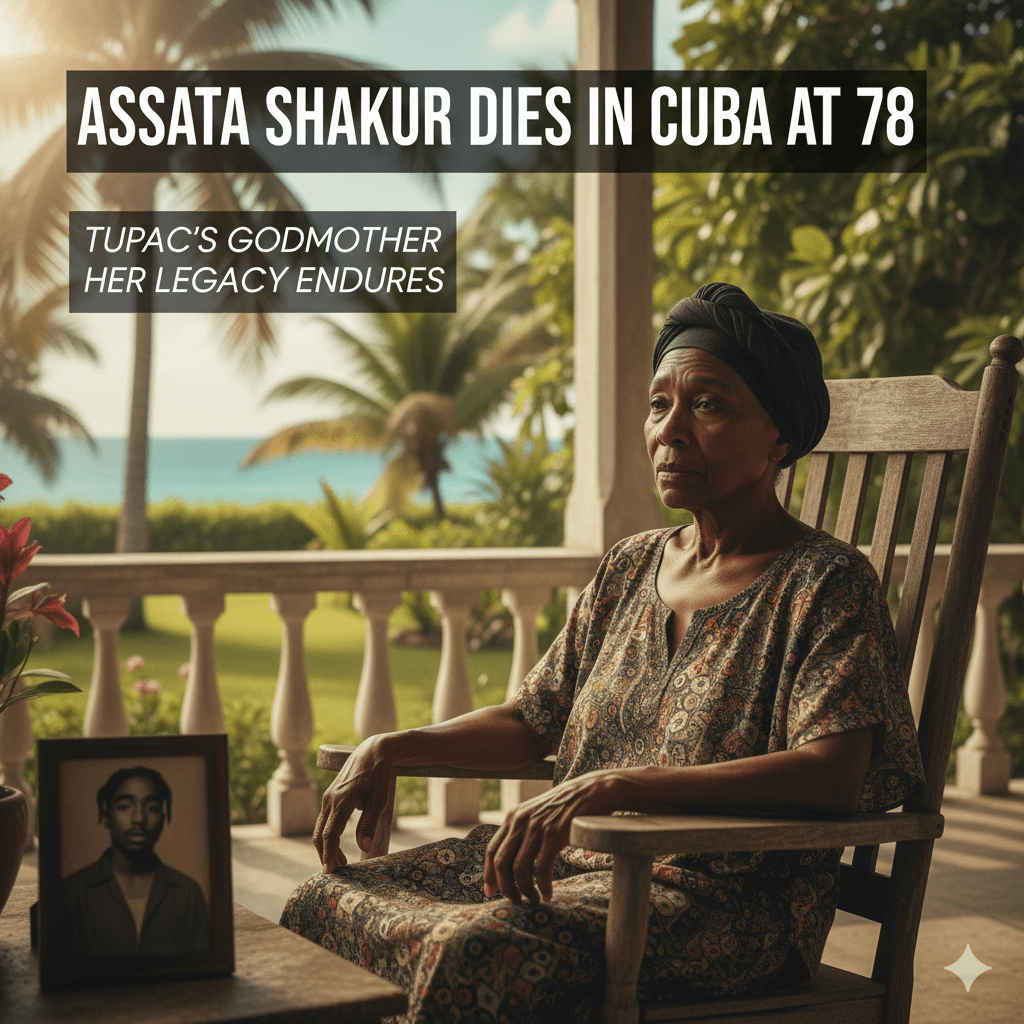
The Assata Shakur death has been confirmed by Cuban authorities and her family, marking the end of a controversial life that spanned decades of political activism and exile. Assata Shakur, the godmother of legendary rapper Tupac Shakur, died in Havana, Cuba on September 25, 2025, at the age of 78 from health complications related to advanced age.
Her daughter announced the tragic news on Facebook, writing that Assata “took her last earthly breath” Thursday afternoon, expressing that “words cannot describe the depth of loss that I am feeling at this time.” The Cuban Ministry of Foreign Affairs subsequently released an official statement confirming her death in Havana.
Revolutionary Life and Black Liberation Army Connection
Born JoAnne Deborah Byron on July 16, 1947, in Flushing, Queens, Assata Shakur became one of America’s most wanted fugitives following her 1977 conviction for the murder of New Jersey State Trooper Werner Foerster during a 1973 shootout on the New Jersey Turnpike. She was a prominent member of the Black Liberation Army (BLA) and briefly associated with the Black Panther Party during the height of the civil rights movement.
Shakur’s adopted name held deep significance in her activist identity – “Assata” means “she who struggles,” “Olugbala” means “the one who saves,” and “Shakur” means “the thankful one.” These names reflected her commitment to the black liberation cause and her role as a revolutionary figure during one of America’s most turbulent periods.
Her case became emblematic of the FBI’s COINTELPRO surveillance program, which targeted black activists and organizations. The FBI had issued nearly daily briefings on her status through what would later become the Joint Terrorism Task Force, and she was subject to intensive manhunts that attempted to connect her to numerous crimes involving the BLA.
Decades in Cuban Exile and Political Asylum
After escaping from prison in 1979, Shakur fled to Cuba where she was granted political asylum by the Castro government. She remained there for over four decades, becoming a symbol of resistance for some and a fugitive from justice for others. The FBI maintained a $1 million reward for information leading to her capture, with an additional $1 million offered by the New Jersey Attorney General.
Her exile in Cuba became a significant diplomatic issue between the United States and Cuba. In 2017, President Donald Trump specifically mentioned her case during a speech about U.S.-Cuba relations, calling for the return of “the cop-killer Joanne Chesimard” as a condition for improving diplomatic ties. Trump’s administration maintained that the return of fugitives from justice, including Shakur, was essential for any normalization of relations.
Throughout her time in Cuba, Shakur maintained her innocence regarding the trooper’s death, claiming she was targeted due to her political activities. Her supporters argued that she was a victim of government persecution and racial injustice, while law enforcement maintained that she was a dangerous criminal who had evaded justice.
Connection to Tupac Shakur and Cultural Impact
Assata Shakur’s relationship to Tupac Shakur brought her story to a new generation through hip-hop culture. As Tupac’s godmother and step-aunt, she influenced the rapper’s political consciousness and artistic expression. Tupac frequently referenced her in his music and interviews, crediting her with shaping his understanding of social justice and black liberation.
Her autobiography, published in 1987, became required reading in many African American studies programs and influenced countless activists and artists. The book detailed her experiences with racism, police brutality, and the criminal justice system, themes that would later resonate throughout hip-hop culture and social justice movements.
The timing of her death comes as discussions about police reform, systemic racism, and criminal justice continue to dominate American political discourse. Her story remains controversial, with some viewing her as a freedom fighter who was persecuted for her beliefs, while others see her as a criminal who escaped justice for decades.
Her death in Cuba closes a chapter on one of the most polarizing figures in American activist history, ending a story that spanned from the civil rights era through the modern Black Lives Matter movement. The Cuban government’s confirmation of her death officially concludes one of the longest-running fugitive cases in FBI history.