

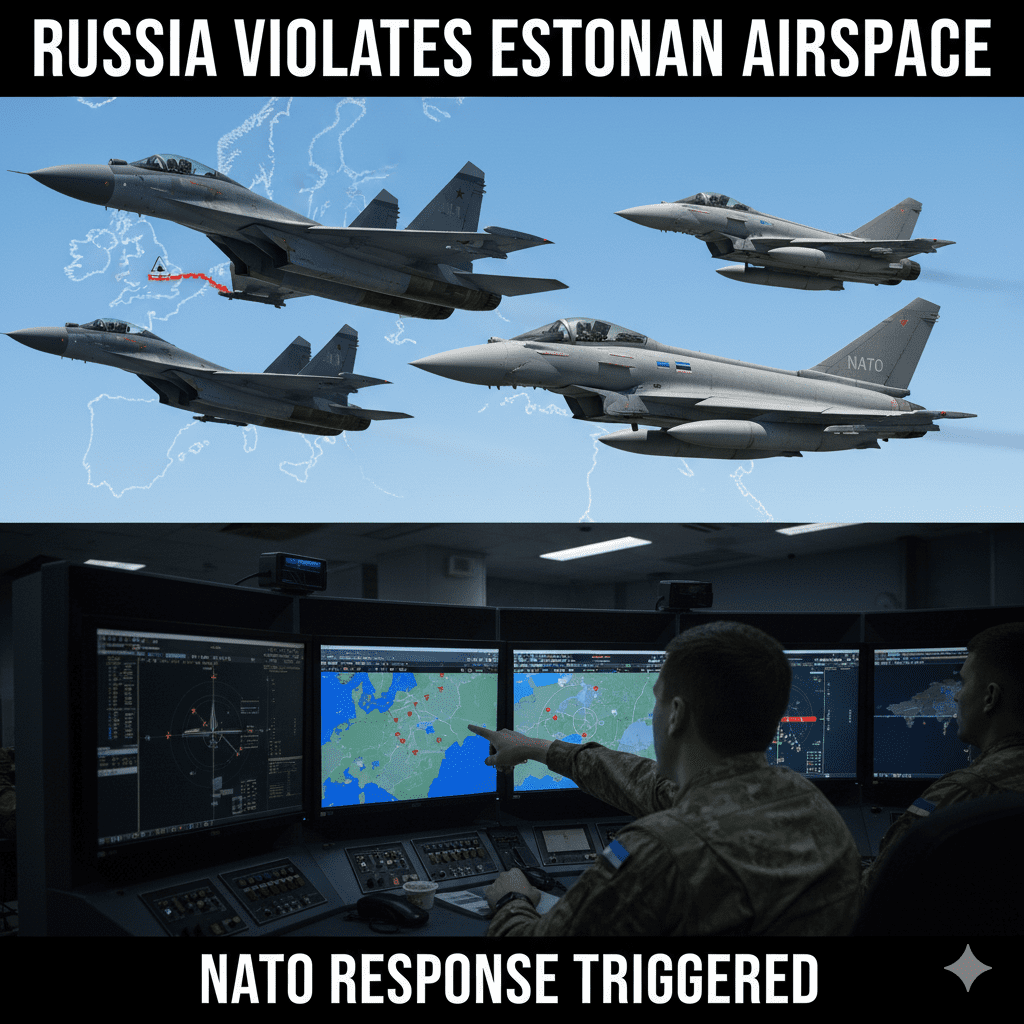
A significant Russia Estonia airspace violation has escalated tensions in Eastern Europe after three Russian MiG-31 fighter jets penetrated Estonian sovereign territory on September 19, 2025, prompting NATO to invoke Article 4 consultations. The incident, which lasted approximately 12 minutes near Vaindloo Island over the Gulf of Finland, represents one of the most serious airspace breaches in the Baltic region in recent years.
Unprecedented Scale of Airspace Violation
According to the Estonian Ministry of Defense, the three Russian MiG-31 Foxbat fighter aircraft flew into Estonian airspace without flight plans, with their transponders switched off, and failed to respond to Estonian air traffic control communications. NATO forces, specifically Italian F-35 jets operating under the Baltic Air Policing mission, were immediately scrambled to intercept and escort the Russian aircraft away from Estonian territory.
The Estonian government characterized this Russia Estonia airspace incident as “an unprecedentedly brazen violation” of its sovereignty, emphasizing the deliberate and extended nature of the intrusion. Unlike typical “border brushing” maneuvers that usually last only seconds, this 12-minute penetration by three fighter jets represents a significant escalation in Russian testing of NATO’s defensive capabilities and resolve.
NATO’s Strategic Response and Article 4 Implications
Estonia has formally invoked NATO’s Article 4, which allows any alliance member to request consultations when they feel their territorial integrity, political independence, or security is threatened. This move ensures that all NATO allies must now discuss a collective response to the Russia Estonia airspace violation, potentially leading to stronger political statements, additional military deployments, or heightened readiness across the Baltic region.
The quick response by Italian F-35s demonstrated both the effectiveness of NATO’s Baltic Air Policing mission and the alliance’s ability to respond rapidly to airspace incursions. However, the incident underscores the ongoing challenges of managing tensions in the Baltic region, where national borders, international airspace, and military patrol routes converge within a relatively confined geographic area.
Regional Security Implications and Russian Denial
Russia’s Ministry of Defense has flatly rejected Estonia’s account of the airspace violation, claiming the aircraft were conducting a routine mission from Karelia to Kaliningrad while remaining over neutral waters of the Baltic Sea. Russian officials insist the jets never came closer than three kilometers to Estonian territory and were flying “in strict accordance with international rules.”
This denial follows a familiar pattern in regional security disputes involving Russian military aircraft and NATO airspace. The conflicting narratives highlight the challenges in verifying such incidents and the potential for escalating tensions based on different interpretations of the same events. For Estonia, a small NATO member sharing both land and maritime borders with Russia, this Russia Estonia airspace incident reinforces long-standing concerns about vulnerability and the need for continued alliance support.
Broader Pattern of Airspace Testing
The Estonia incident is not isolated, as similar events have been reported in Poland and Romania, suggesting a coordinated pattern of probing and testing by Russian forces across NATO’s eastern flank. According to recent analysis, there has been a 25% increase in reported airspace violations by Russian aircraft near NATO borders over the past year, raising concerns about intelligence gathering, defense testing, and the increased risk of miscalculation.
These violations serve multiple strategic purposes for Russia, including testing NATO’s air defense capabilities, gathering intelligence on radar systems and communication networks, and demonstrating Moscow’s willingness to challenge the existing security architecture in Eastern Europe. The incidents also carry significant risks, as close encounters between military aircraft increase the possibility of accidental escalation that could trigger broader conflict.