

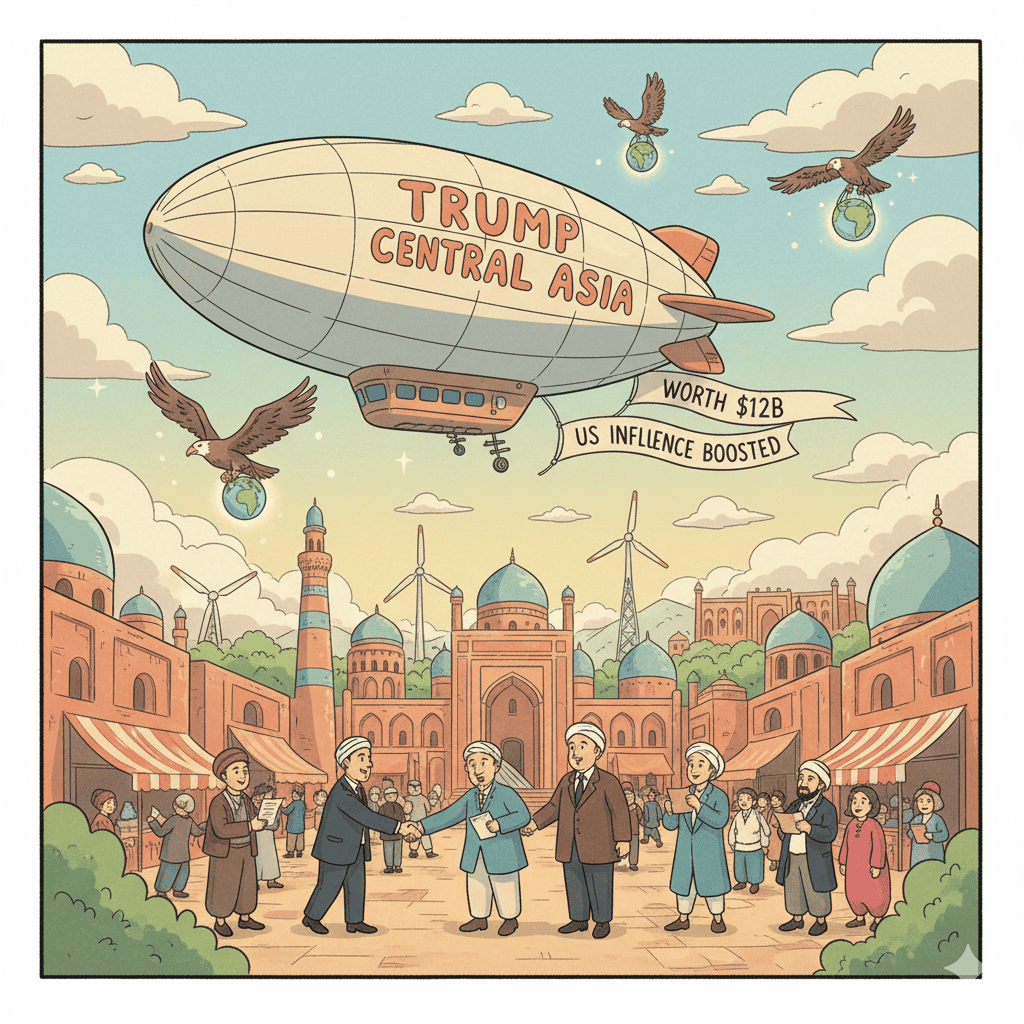
President Donald Trump has secured landmark Trump Central Asia trade agreements worth over $12 billion with Uzbekistan and Kazakhstan, marking a significant strategic pivot toward the resource-rich region. The deals, announced during the United Nations General Assembly in New York, represent the largest US commercial engagement with Central Asia in recent history and signal Washington’s intent to counter Chinese and Russian influence in the strategically vital corridor.
The comprehensive agreements include Uzbekistan’s commitment to purchase up to 22 Boeing aircraft valued at more than $8 billion, while Kazakhstan signed a record-breaking $4.2 billion rail deal with Pennsylvania-based Wabtec Corporation for 300 locomotives. US Commerce Secretary Howard Lutnick described the Kazakh rail contract as the “largest rail deal in US history” during the signing ceremony attended by both nations’ presidents.
Strategic Competition in Central Asia
These Trump Central Asia initiatives represent a calculated effort to establish the United States as a dominant economic partner in a region traditionally dominated by China and Russia. Both Uzbekistan and Kazakhstan possess abundant natural resources, including oil, natural gas, uranium, and rare earth minerals critical to modern technology and defense applications. The timing of these agreements coincides with growing US concerns about China’s Belt and Road Initiative and Russia’s continued influence through energy partnerships.
Trump personally praised the deals on his Truth Social platform, highlighting Uzbekistan President Shavkat Mirziyoyev as “a man of his word” and congratulating Kazakhstan President Kassym-Jomart Tokayev on his “great purchase.” The US president emphasized that the Boeing deal alone would create “over 35,000 jobs” in the United States, linking the international agreements to domestic economic benefits.
Economic and Geopolitical Implications
The significance of these Trump Central Asia partnerships extends beyond immediate commercial gains. Central Asia serves as a crucial land bridge connecting Europe, Asia, and the Middle East, making it strategically valuable for trade routes and energy transportation. The region’s vast uranium reserves are particularly important, as Kazakhstan is the world’s largest uranium producer and a key supplier to US nuclear power plants.
American energy giants Chevron and ExxonMobil have substantial investments in Kazakhstan’s oil fields, while the country has maintained an “enhanced strategic partnership” with the United States since 2017. The new agreements build upon this foundation, creating overlapping partnerships that strengthen American influence while promoting economic diversification away from traditional Russian and Chinese dependencies.
The deals also support the development of the Middle Corridor, an emerging trade network designed to facilitate commerce between Central Asia and Western markets. This infrastructure project offers an alternative to traditional routes through Russia, potentially reducing regional dependence on Moscow’s transportation networks.
Industry analysts note that these agreements reflect Trump’s transactional approach to foreign policy, combining commercial interests with strategic objectives. The Export-Import Bank supported the Kazakh rail deal with a $400 million loan, demonstrating the administration’s commitment to backing US businesses in the region through financial tools and diplomatic engagement.
The timing of these announcements during the UN General Assembly also served to highlight America’s renewed engagement with Central Asia on the global stage, sending clear signals to both regional competitors and international observers about US priorities in this strategically important region.