

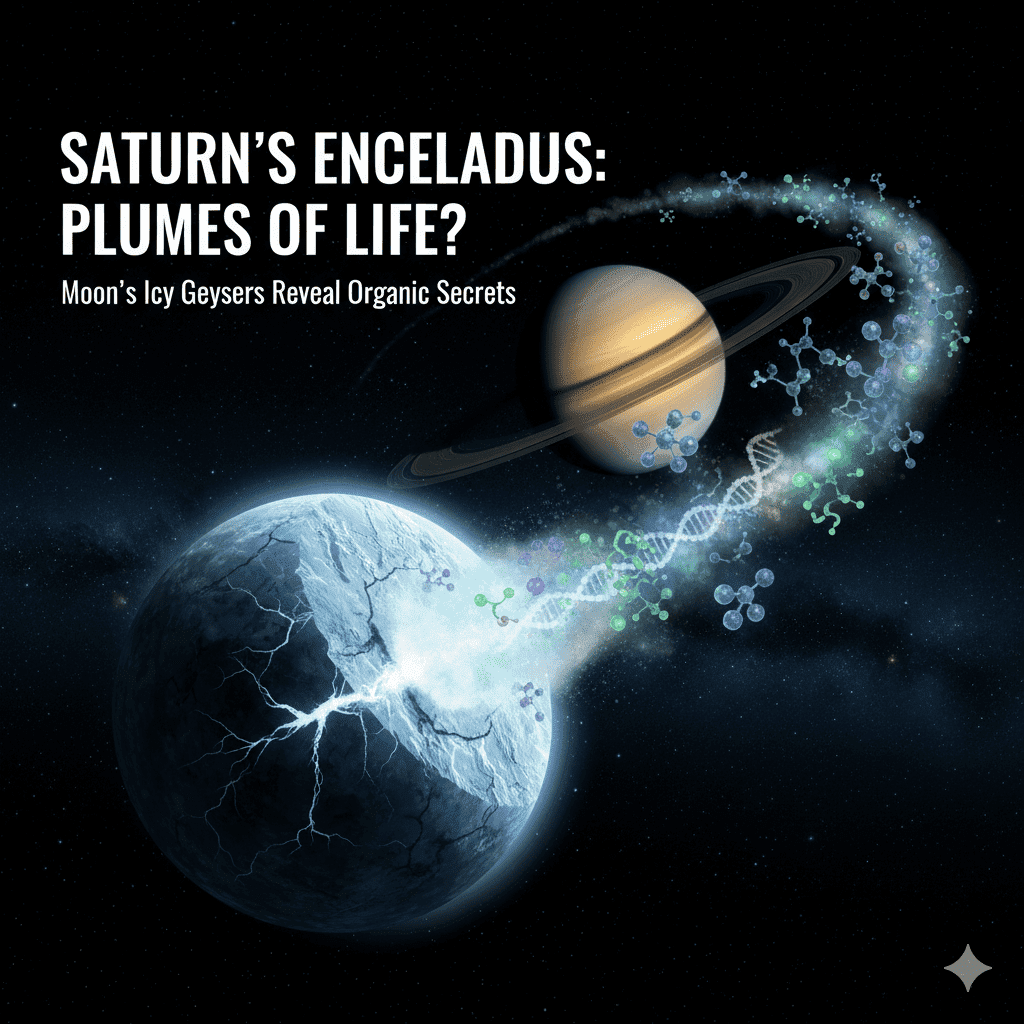
Recent research has revealed that the Saturn moon Enceladus contains complex organic molecules, reinforcing its status as a prime candidate for hosting extraterrestrial life. This small icy moon, roughly 500 kilometers wide, conceals a vast saltwater ocean beneath its frozen surface, where key ingredients for life appear to exist.
Organic Molecules Discovered in Enceladus’ Icy Geysers
<pNASA's Cassini spacecraft, during its mission from 2004 to 2017, performed multiple flybys of Enceladus, detecting plumes of water erupting through surface cracks near the moon's south pole. In 2008, Cassini flew through these icy geysers, collecting tiny ice grains propelled into space. A new analysis of these grains revealed a variety of complex organic compounds, including salt, methane, carbon dioxide, and phosphorus—elements essential for life.
Scientists noted that these ice grains collided with Cassini’s cosmic dust analyzer at very high speeds (around 40,000 mph), providing clearer chemical data than previously available. The discovery of these organics bolsters the hypothesis that Enceladus’ subsurface ocean could be habitable, although no direct evidence of life has yet been found.
Implications for Astrobiology and Future Missions
Enceladus’ combination of water, organic molecules, and energy sources positions it as one of the most promising locations in the solar system to search for life beyond Earth. Researchers emphasize that being habitable does not confirm the presence of life, but it highlights the moon’s potential.
Future missions could target Enceladus to collect fresh samples from its surface or plumes, which contain pristine biosignatures from the hidden ocean. Scientists are optimistic that these findings will guide the design of spacecraft capable of further exploring the moon’s intriguing environment.
As Fabian Klenner from the University of Washington, part of the research team, explained, “We believe that Enceladus is habitable, but we do not know if life is indeed present.” This nuanced understanding drives ongoing interest in this icy world orbiting Saturn.